

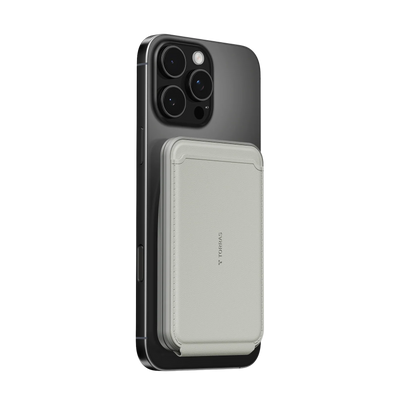


Losing your wallet because it slid off your phone in a crowded commute or while pulling it from your pocket is a sinking feeling many iPhone users know too well. A strong magnet alone often isn't enough. Real security comes from how the wallet resists the sideways tug of fabric edges, the twist of one-handed use, and the gradual weakening that happens over months of daily carry.
Why Most MagSafe Wallets Fail the Pocket Test
The most common failure isn't a straight yank that rips the wallet off. It's lateral shear. When you slide your phone into a tight denim pocket, the top edge of the fabric catches the wallet and tries to drag it sideways. Many wallets that feel rock-solid when you first snap them on simply glide away under this kind of pressure.
Marketing tends to focus on vertical pull force and the satisfying click. That click tells you the main ring magnet has engaged, but it says little about what happens when your hand or pocket applies force from the side. In everyday life, that lateral movement is the real test.
This is the so-called 'Ice Rink' effect. An N52 magnet paired with a smooth plastic or polished leather surface can hold tight straight on but offers almost no resistance once it starts to slide. The wallet spins or shears off with surprising ease, especially during repeated pocket entries or when you're walking and using the phone one-handed.
Understanding the difference between vertical pull and lateral resistance helps explain why some seemingly strong wallets still end up lost. The magnet provides the initial clamp. The contact surface determines whether that clamp survives real movement.
Decoding Magnet Grades: Why N52 Is the Baseline for Security
Magnet grades refer to the maximum energy product, or BHmax, of the neodymium material. This technical breakdown from Stanford Magnets shows that N52 offers roughly 50% more pull force than the common N35 grade in the same size.
Lower-grade magnets often feel mushy. The attachment lacks the crisp alignment that keeps the wallet precisely centered on the MagSafe ring. Over time that slight play turns into noticeable wobble, especially when the phone is in a bag or you reach for it quickly.
For a wallet that carries your ID and cards, that extra strength matters. N52 has become the baseline in serious EDC accessories because it delivers the snap and retention needed to survive daily handling. Weaker grades can work in controlled environments, but they tend to disappoint once you start commuting, driving, or moving between pockets and desks.
Keep in mind that raw magnet strength is only part of the story. Without the right supporting design, even an N52 wallet can let you down in real use.
The Friction-Magnet Security Matrix: Beyond the Click
Friction-Magnet Security Matrix
This matrix highlights the likely security profile of common magnet and backing combinations for pocket carry and one-handed use. Higher magnet force helps retention, but lateral friction from the backing is what helps prevent pocket-edge slip.
View chart data
| Scenario | Smooth leather/plastic | Textured silicone |
|---|---|---|
| N35 | 1.0 | 2.0 |
| N52 | 2.0 | 3.0 |
A strong magnet on a slick case creates that ice-rink problem I mentioned earlier. The vertical hold feels reassuring in your hand, yet the wallet slides the moment it meets resistance. Material comparisons show that silicone or heavily textured surfaces can deliver noticeably higher lateral resistance than smooth leather or plastic.
In practice this means the backing acts like a mechanical brake. When I switched from a smooth leather wallet to one with a soft-touch silicone pad, the difference in pocket security was immediate. The silicone version stayed put even when I shoved the phone into tight jeans while rushing for the train.
The vertical alignment magnet, sometimes called the 'tail,' also plays a quiet but critical role. Apple's MagSafe design uses this secondary magnet to stop the accessory from pivoting. Without it, the wallet tends to rotate under your thumb during one-handed use, gradually working itself loose. Many users notice this spinning first in rideshares or coffee shops when they keep checking the phone.
If you carry your phone in smooth cases or frequently use it one-handed in motion, prioritize a wallet that combines an N52 ring with both a high-friction backing and that alignment tail. The combination turns a good click into genuine daily reliability.
The Critical Role of Case Thickness and Material
Even the strongest wallet struggles if your case is too thick. Apple's official guidelines state that MagSafe-compatible cases should stay at or below 2.1 mm thick to maintain proper magnetic flux. Anything thicker creates a gap that weakens the hold dramatically, sometimes by half or more with each extra millimeter.
I learned this the hard way after putting a wallet on a thicker protective case during a trip. The attachment felt decent at first, but within a week the wallet began migrating in my pocket and eventually came off completely while I was getting out of a car.
Some materials marketed as grippy can actually interfere with the magnetic field. Thick TPU or certain textured plastics may feel secure in your hand but reduce the effective pull of the magnets. Smooth, thin cases usually perform best, though they then require the wallet itself to supply the friction.
Before buying, check your current case thickness. If it's over that 2.1 mm limit or feels spongy, consider swapping to a true MagSafe-rated slim case. The improvement in wallet security is usually worth it.

The Pocket-Proof Test Framework: A 60-Second Security Audit
The audible click is reassuring but not a complete test. A quick set of checks you can do at home predicts real-world survival far better.
Start with the shear catch. Attach the wallet, then slide the phone into a tight pocket several times as you would during a normal day. Watch whether the wallet shifts or catches on the fabric lip. If it moves more than a couple of millimeters consistently, it will likely fail over time.
Next, test rotational stability. Hold the phone in one hand and rotate your thumb across the wallet as if scrolling or adjusting your grip. A good alignment tail should prevent noticeable spinning. If the wallet twists easily, it will gradually loosen during commuting or when you set the phone on a car mount.
Finally, do the friction slide. With the phone on a table, push the wallet sideways with your thumb. There should be clear resistance before it starts to move. On smooth combinations this test often reveals how quickly the wallet would shear off in a pocket.
These checks take less than a minute but reveal far more than marketing claims. I now run them on every new accessory, and they've saved me from several purchases that looked perfect on paper.
The Secure Carry Checklist: Final Decision Rules
Don't choose a MagSafe wallet based on magnet grade alone. Look for an N52 ring paired with a textured or silicone backing if you use smooth cases. Confirm the presence of that vertical alignment magnet to stop spinning during one-handed use.
Your case must be 2.1 mm or thinner for reliable performance. Thicker cases turn even premium wallets into temporary accessories that eventually let you down.
Built-in magnetic shielding that meets ISO 7810 standards protects your cards from demagnetization. This feature has become standard in better wallets, but it's still worth verifying if you carry multiple credit cards.
In daily life the best wallets feel slightly grippy rather than perfectly smooth. They stay put when you drop the phone into a bag or pocket quickly, and they don't slowly migrate during a long commute. After a few months of use, the backing should still provide the same friction instead of polishing smooth from pocket wear.
How Strong Should a MagSafe Wallet Magnet Be?
N52 is the practical minimum for daily carry that includes frequent pocket use. Lower grades can work for occasional desk-to-bag movement but tend to loosen faster under repeated shear. The extra energy in N52 translates to a crisper attachment that resists the small movements that eventually cause failure.
Do Smooth Phone Cases Make MagSafe Wallets Less Secure?
Yes, in most cases. Smooth cases reduce lateral friction, so the wallet relies almost entirely on the magnet and any textured pad on the wallet itself. If you prefer slim, glossy cases, look for a wallet with a pronounced silicone or rubberized backing. Without it, expect more frequent readjustments and higher risk of detachment in pockets.
Can a MagSafe Wallet Damage Credit Cards?
Modern designs with proper internal shielding do not damage cards. The shielding blocks the field from reaching the magnetic stripe, meeting the requirements of ISO 7810 standards. Still, keep cards in the wallet's dedicated slots rather than loose against the phone, and avoid prolonged direct contact with the magnet ring.
How Do I Know If My Current Case Is Too Thick for a Wallet?
Measure the case at its thickest point near the camera or edges. If it exceeds 2.1 mm or feels substantially thicker than a standard slim MagSafe case, the wallet attachment will be compromised. A simple test is to see whether the wallet sits flush and clicks solidly without any visible gap or wobble.
Are Slim MagSafe Wallets Less Secure Than Thicker Ones?
Not necessarily. Slim wallets can be more secure if they use high-grade N52 magnets, proper alignment features, and textured contact surfaces. Bulkier designs sometimes add unnecessary material that actually reduces magnetic effectiveness. Focus on the combination of magnet strength, friction, and thin case compatibility rather than overall thickness alone.
For more on choosing the right magnetic accessories, see our guide on how magnetic phone cases work. If you're shopping for options that balance slim design with strong retention, explore the MagSafe Wallet collection. Many users also like pairing a wallet with one of the Ostand Q3 Spin for iPhone 16 Pro Max cases for added versatility. Check our Magnetic Phone Wallet Guide for further details on all-day carry performance.

 New
New


TORRAS Bot
The TORRAS Pebble Power Bank offers a balanced combination of portability, design quality, and dependable charging performance. Its unique pebble-inspired shape distinguishes it from traditional power banks while improving everyday usability.