



Every phone case box promises protection, but the language behind those promises varies more than most people realize. Drop resistant, drop proof, and military-grade are not interchangeable terms, and the number printed on the packaging tells only part of the story. Knowing how to read a drop proof phone case claim before you buy saves you from a case that sounds protective but fails when it matters most.
What Drop Resistant and Drop Proof Mean on a Phone Case Label
The phone case industry does not use a single universal standard for drop-related claims. Different brands use different terms, and the same term can mean different things depending on who is using it. A few definitions worth knowing:
- Drop resistant generally means the case has been designed or tested to reduce the risk of damage from drops. It is a broad term with no fixed height requirement. A case labeled drop resistant could have been tested at waist height or table height, and the label alone does not specify which.
- Drop proof implies a higher level of confidence, suggesting the case can survive a drop without damage to the phone. In practice, it is still a marketing claim rather than a certified standard, and the conditions behind it vary widely between brands.
- Military-grade drop protection refers to testing that follows MIL-STD-810G or MIL-STD-810H, which are United States Department of Defense durability testing standards. When applied to phone cases, this typically means the case passed Method 516.8, which requires drops from multiple angles onto a steel plate. The standard does not specify a minimum drop height, so a case can claim military-grade certification after passing drops from a relatively low height.
The practical takeaway is that none of these labels is regulated. They signal that some level of testing occurred, but the specific conditions behind the label matter far more than the label itself.

How Drop Test Conditions Change What a Phone Case Drop Test Rating Actually Proves
A drop height number is the most visible spec on any phone case drop test rating, but it is also the most incomplete. Two cases with the same rating can be tested under completely different conditions and deliver completely different real-world results. Test surface, drop count, and angle coverage all determine what that number actually means.
The Test Surface Changes Everything
The surface a phone lands on determines how much energy the case must absorb. Concrete and steel plate transfer nearly all impact force into the case. Plywood and padded flooring absorb some energy before the case even responds.
A case rated for a certain height on a padded surface may not perform the same way on tile or concrete, which is where real drops actually happen. When a brand does not specify the test surface alongside the drop height, that missing detail is worth questioning.
Drop Count and Angle Coverage Reveal the Full Picture
A single-drop pass or fail test is the weakest form of drop certification. More rigorous protocols run the same device through multiple drops from different angles, including corner drops.
Corner drops concentrate all kinetic energy, which is the energy of a moving object, into a contact area of just a few square millimeters. A case that survives flat-face drops but has no dedicated corner protection will fail at the exact point where real damage most often occurs. When evaluating any drop test rating, the details to look for are the test surface, drop count, and whether corner angles are included.
Why Two Drop Proof Phone Cases With the Same Rating Can Perform Very Differently
Two cases can both print the same drop height on their packaging and behave completely differently when a phone actually hits the ground. The difference comes down to what is inside the case, not just the number on the box.
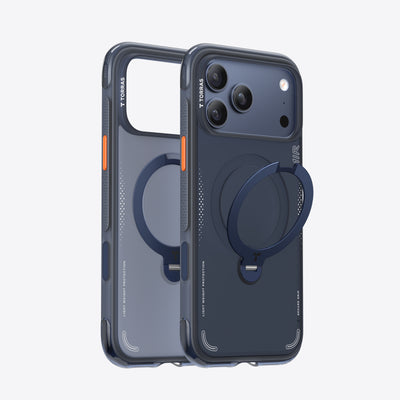
Material construction is the core variable. A case built with a single layer of TPU, which stands for thermoplastic polyurethane and is a flexible rubber-like plastic commonly used in phone cases, absorbs impact through the deformation of that one material. A case built with dual-layer construction, typically combining a rigid polycarbonate outer shell with a flexible TPU inner layer, handles both the initial impact force and the structural load that follows more effectively.
Corner geometry matters just as much. Air-cushion technology, which places hollow sealed chambers at the corners and edges of a case, allows the case to compress further on impact and spread force over a larger area and longer time window. This reduces the peak force reaching the phone frame during a corner drop, which is the scenario most likely to crack a screen or bend a chassis. A case without dedicated corner geometry may pass a flat-face drop test at the same height but fail a corner drop under real conditions.
A few things to look for when comparing two drop resistant phone cases with similar ratings:
- Multi-layer construction rather than single-material design
- Air-cushion or air-gap corner protection specifically mentioned in the product details
- Raised bezels around the screen and camera, which prevent direct contact with flat surfaces during a face-down drop
- Material specifications listed by name rather than vague terms like protective or rugged

How to Choose a Drop Resistant Phone Case That Lives Up to Its Claims
Once you know what the numbers mean and what they do not tell you, evaluating a specific case becomes much more straightforward. A few checks before buying filter out most cases that look good on paper but underperform in real use:
- Find the test surface. If the product listing shows a drop height but does not mention the surface it was tested on, that is missing information worth looking for before committing.
- Check for corner-specific protection. Look for descriptions that mention air-cushion corners, reinforced corner bumpers, or air-gap technology. A case that addresses corner drops specifically has a more complete protection design than one that only mentions overall height.
- Look for multi-layer or hybrid construction. Cases that combine rigid and flexible materials handle the different phases of a drop event more effectively than single-material designs.
- Read the protection language carefully. Terms like tested, certified, and rated carry more weight than resistant or proof alone, particularly when accompanied by a disclosed test protocol.
Know What You Are Buying Before the First Drop Happens
A drop proof phone case claim is only as reliable as the testing conditions behind it. Check the test surface, look for corner-specific protection, and confirm the construction goes beyond a single layer of generic material. A well-built drop resistant phone case is one where the design details match the rating on the box. Find the case that shows its work and carries your phone with confidence.
FAQs
Q1. Is Drop Resistant the Same as Drop Proof for Phone Cases?
No, the two terms are not equivalent, though neither is regulated by an industry-wide standard. Drop resistant generally implies reduced risk of damage from drops without a specific protection guarantee, while drop proof suggests the case can prevent damage entirely under the tested conditions. In practice, the testing conditions behind both labels vary widely between brands, which is why checking the specific drop height and test surface is more informative than relying on either term alone.
Q2. What Height Should a Drop Resistant Phone Case Protect Against?
Most everyday drops happen from pocket height, waist height, or table height, which typically falls in the range of three to five feet. A drop resistant phone case tested at six feet or higher covers these everyday scenarios with meaningful margin. Cases tested at lower heights may still offer real protection for typical use, but the test height should always be read alongside the test surface to assess how relevant the rating is to real conditions.
Q3. Does a Drop Resistant Case Need to Pass a Military Standard Test?
A military standard certification, such as MIL-STD-810G or MIL-STD-810H, is a useful signal that structured testing occurred under disclosed conditions. However, it is not the only indicator of a well-built drop resistant case, since the standard does not specify a minimum drop height, and the value of the certification depends on how transparently the brand discloses the test conditions alongside the badge. Corner protection design, material construction, and disclosed test conditions together give a more complete picture of real-world performance than any single certification label.
Q4. What Should I Look for Beyond the Drop Height Number When Buying a Phone Case?
The test surface is the first additional detail to find, since a drop onto steel or concrete is significantly more demanding than a drop onto padded flooring. Corner-specific protection, such as air-cushion chambers or reinforced corner geometry, addresses the drop angle most likely to cause real damage. Multi-layer construction and raised bezels around the screen and camera round out what a well-designed drop resistant phone case should include beyond the height number alone.

 New
New


TORRAS Bot
The TORRAS Pebble Power Bank offers a balanced combination of portability, design quality, and dependable charging performance. Its unique pebble-inspired shape distinguishes it from traditional power banks while improving everyday usability.